
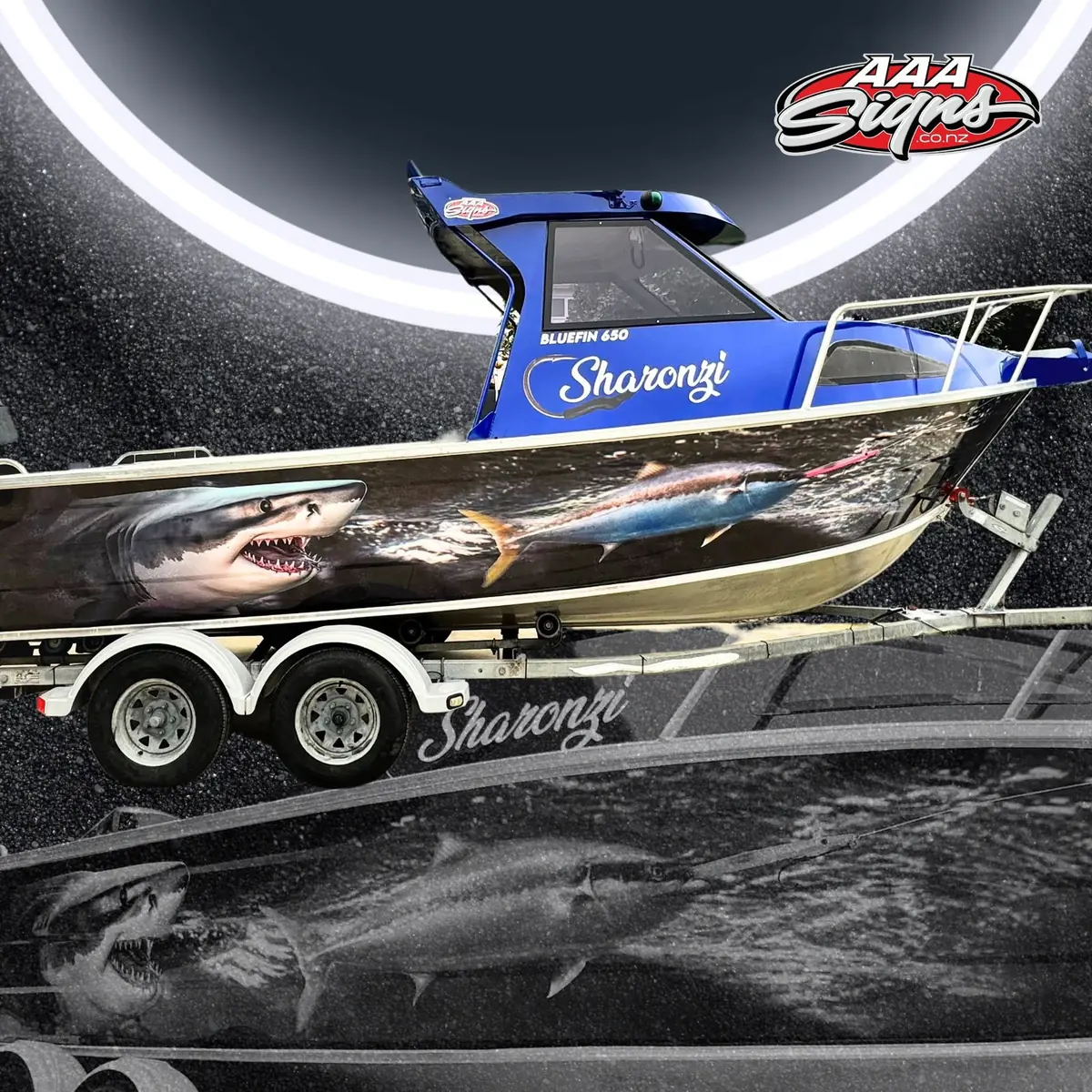
People are often surprised that we wrap boats at all. The technique carries over from vehicles, but the surface, the shape and the conditions are different enough that it's worth treating as its own discipline.
The shape works against you
A car has flat-ish panels separated by seams and gaps you can hide an edge in. A hull is one continuous compound curve that changes as it runs fore and aft — it's convex in two directions at once through much of its length. Vinyl doesn't naturally want to do that. It has to be heated and stretched deliberately, and the pattern has to be planned so the artwork doesn't distort as it follows the curve.
That planning matters most when the graphic contains something the eye knows the shape of. On the Bluefin 650 we wrapped for a local owner, the artwork ran a shark and a bluefin tuna the length of the hull. A fish that stretches unevenly across a curve looks wrong immediately, even to someone who couldn't tell you why — so the layout has to account for the hull's shape before anything is printed.
The environment is harsher
A wrapped work van lives a fairly gentle life by comparison. A boat gets:
- Saltwater, which is aggressive on any adhesive edge it can get into.
- Constant unshaded UV, on the water and usually on the trailer too — no carport, no shade.
- Trailer contact, where rollers and bunks rub the hull every single time it's launched and retrieved.
- Pressure washing, which is how most people clean a boat after a day out.
That combination means edge sealing and laminate choice matter more than they do on a vehicle. Every edge is a place saltwater can start lifting the film if it hasn't been properly wrapped around or sealed.
Preparation is different too
Gelcoat isn't automotive paint. It's more porous, it oxidises with sun exposure, and older hulls often have a chalky surface layer that has to come off before anything will bond properly. Any wax or polish that's been applied over the years also has to be removed completely — wax is designed to stop things sticking to your hull, which is exactly the problem.
Why do it at all?
Two reasons, usually. The first is cost: re-gelcoating or professionally repainting a hull is a serious job, and a wrap achieves a full visual change for a fraction of it. The second is that a wrap can carry artwork that paint realistically can't — photographic detail, gradients, complex illustration — and it can come off later without touching what's underneath.
For a charter or fishing business, there's a third: a distinctive boat at the ramp is advertising, in front of exactly the audience you want.
If you're weighing up a hull wrap, send us photos of the boat and its current condition. Gelcoat age and surface condition are the two things that most affect whether it's a straightforward job or one needing significant prep.